


Author:AInvest
Ripple's RLUSD has emerged as a formidable contender in the regulated stablecoin space, leveraging a dual-chain deployment strategy on the
Ledger (XRPL) and to address institutional demand for efficiency, compliance, and scalability. As the stablecoin market evolves, RLUSD's unique positioning-combining high-throughput cross-border capabilities with DeFi integration-positions it to capture significant market share, particularly among institutional players seeking alternatives to legacy stablecoins like and .Multi-Chain Infrastructure: Bridging Speed and Ecosystem Access
RLUSD's deployment on both the XRP Ledger and Ethereum is a masterstroke of technical design. The XRP Ledger, with its sub-5-second settlement times, 1,500+ transactions per second (TPS), and near-zero fees,
. Meanwhile, Ethereum's integration allows RLUSD to for yield generation and collateralization, a critical use case for institutional portfolios. This dual-chain approach ensures that RLUSD can serve as both a high-speed settlement tool and a DeFi-native asset, addressing two of the most pressing needs in institutional finance.Data from late 2025 reveals that Ethereum hosts approximately 80% of RLUSD's supply ($1.02 billion), while the XRP Ledger accounts for 20%
. However, the XRP Ledger's issuance has surged by 92.6% year-to-date, for its efficiency in cross-border corridors. This growth is further amplified by Ripple's partnerships with entities like DBS and Securitize, which are and treasury operations.Regulatory Clarity: A Differentiator in a Crowded Market
Unlike USDT and even USDC, RLUSD's regulatory alignment is a cornerstone of its appeal. The stablecoin operates under a New York Department of Financial Services (NYDFS) charter and maintains a 1:1 USD peg backed by cash and U.S. Treasuries, with reserves custodied by BNY Mellon and audited by Deloitte
. This transparency has earned it recognition in jurisdictions like Abu Dhabi, where the Abu Dhabi Global Market (ADGM) has greenlisted RLUSD as an "Accepted Fiat-Referenced Token," enabling its use as collateral and in prime brokerage platforms .In contrast, USDC, while compliant and widely adopted, operates on a broader range of blockchains (24+ chains) but lacks the same level of institutional specificity
. USDT, though dominant in liquidity, faces ongoing scrutiny over reserve transparency. RLUSD's focus on institutional-grade compliance and its alignment with frameworks like the U.S. GENIUS Act and EU MiCA make it a safer bet for enterprises navigating regulatory uncertainty.Institutional Adoption: Metrics and Case Studies
RLUSD's institutional adoption is accelerating, driven by its utility in cross-border payments and tokenized finance. As of November 2025, its market capitalization has surpassed $1.26 billion, with over $1 billion in Ethereum-based supply and $225 million on the XRP Ledger
. This growth is underpinned by strategic partnerships in Africa and the Middle East, where RLUSD is being used for B2B settlements and real-world asset (RWA) tokenization .A key case study is the XRP Ledger's role in cross-border corridors. Ripple's ecosystem has enabled financial institutions to
while cutting costs by up to 70% compared to traditional SWIFT transfers. Additionally, XRP ETFs-backed by RLUSD's liquidity-have within weeks of their launch, outpacing and Ethereum ETFs in early adoption. This synergy between RLUSD and XRP's real-world use cases underscores its value capture potential.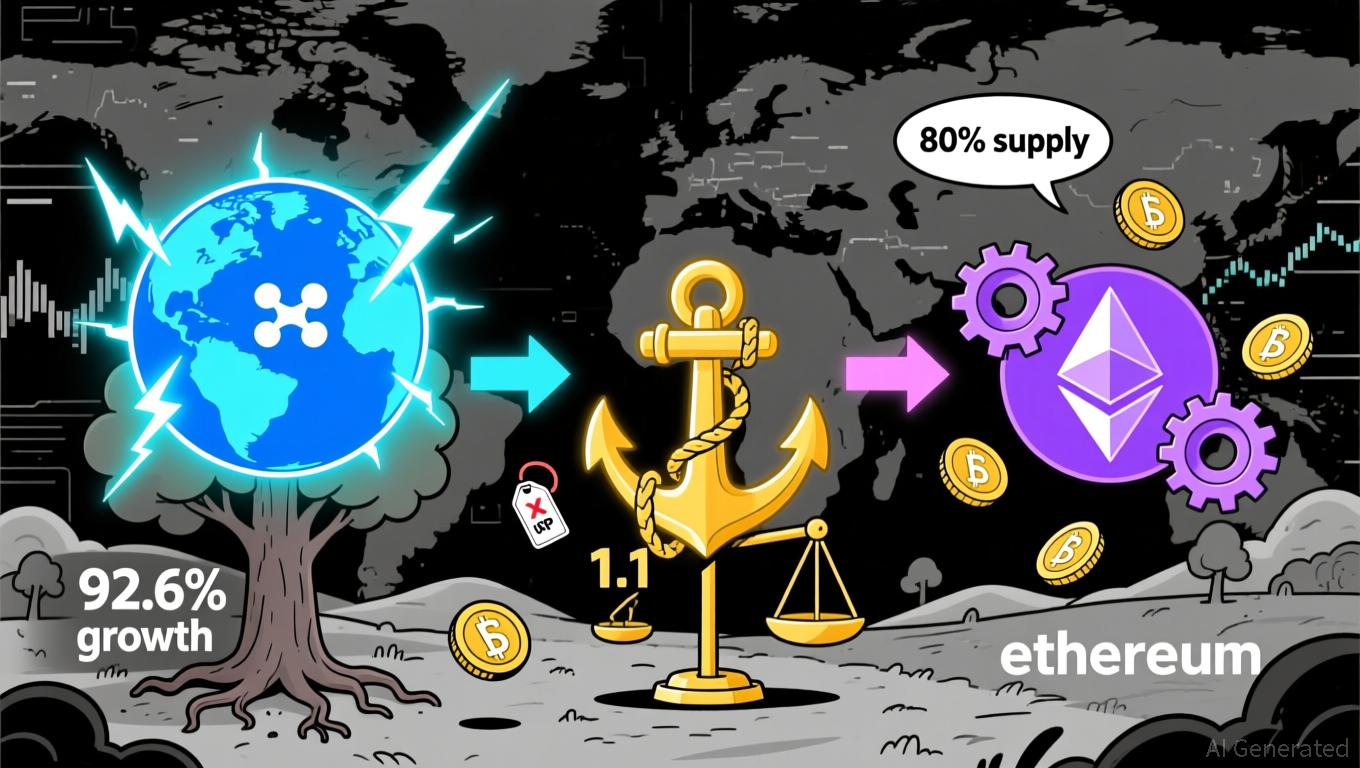
Market Share Potential: Niche vs. Mass Appeal
While USDC dominates with a $61 billion market cap, RLUSD's focus on institutional demand rather than mass adoption gives it a distinct edge in niche markets. Its multi-chain strategy allows it to compete directly with USDC in DeFi collateralization while outperforming USDT in regulatory compliance. Analysts project RLUSD could enter the top five stablecoins by market cap if adoption continues at its current pace, surpassing
($4.44 billion) and challenging USDC's dominance in institutional settings .However, RLUSD's narrower circulation (~$1.26 billion) compared to USDC's scale means it must continue expanding partnerships and use cases to sustain growth. Its recent approval in Abu Dhabi and integration into tokenized asset platforms suggest it is well-positioned to do so
.Conclusion: A Catalyst for Long-Term Value Capture
Ripple's RLUSD represents a paradigm shift in stablecoin design, combining the speed of the XRP Ledger with the composability of Ethereum to serve institutional needs. Its regulatory clarity, institutional partnerships, and multi-chain flexibility position it to capture a growing share of the $10 billion monthly stablecoin settlement market
. As global financial systems increasingly prioritize efficiency and compliance, RLUSD's strategic infrastructure could cement its role as a foundational asset in the tokenized economy.