
















If we compare the crypto industry to a set of teeth, then the path of token listings over the years is like a process of "industry orthodontics." From the chaos of 2017 to the industrialized assembly line of 2025, every token allocation method in the market is essentially a correction of the industry's structural abnormalities and a challenge to the token structure.
In this process, the path for project teams to pursue top-tier liquidity has evolved from the early "voice-driven game" to the current "sky-high dowry model" of offering exorbitant sums; exchanges, in order to survive and acquire traffic and transaction fees, have also shifted from the early listing logic to the pricing logic.
How exchanges, project teams, VCs, and traders destroy and love each other; how they slander and achieve together.
For you, a thousand times over.
introduction
Teeth are a very "magical" organ in the human body. Why is that? Because teeth are the only organ in the human body that, after adulthood, allows us to deeply customize, move, and modify them through physical and biological means.
This "plasticity" allows us to combat the misalignment caused by genes and the wear and tear and discomfort brought by the years.
We usually think of bones as hard and fixed, and that teeth, which grow in the alveolar bone, should remain completely still. However, orthodontics (wearing braces) takes advantage of the fact that bone is a "dynamic and active tissue." When braces continuously apply a constant, light force to the teeth, the alveolar bone on the side of the tooth under pressure will feel the pressure, and the body will send out osteoclasts to absorb the bone in that area, making way for the tooth. On the side where the tooth moves, the body will send out osteoblasts to fill the gap left by the tooth movement.
Teeth simultaneously "destroy" and "rebuild" bone, thus enabling slow movement within the skeleton.
This is something no other hard organ in the human body can do. After all, unless you are exceptionally gifted, you can't shorten your thigh bone or reposition your ribs by applying pressure, but teeth can.
The same applies to the rules and policies for listing coins.
Part 1: Listing on Coin Exchanges = The Struggle and Transfer of Asset Pricing Power
This article divides the path of cryptocurrency listing into four stages: deciduous teeth – teething – malformation – orthodontics. The core issue running through these four stages is: who controls the pricing power of the asset?
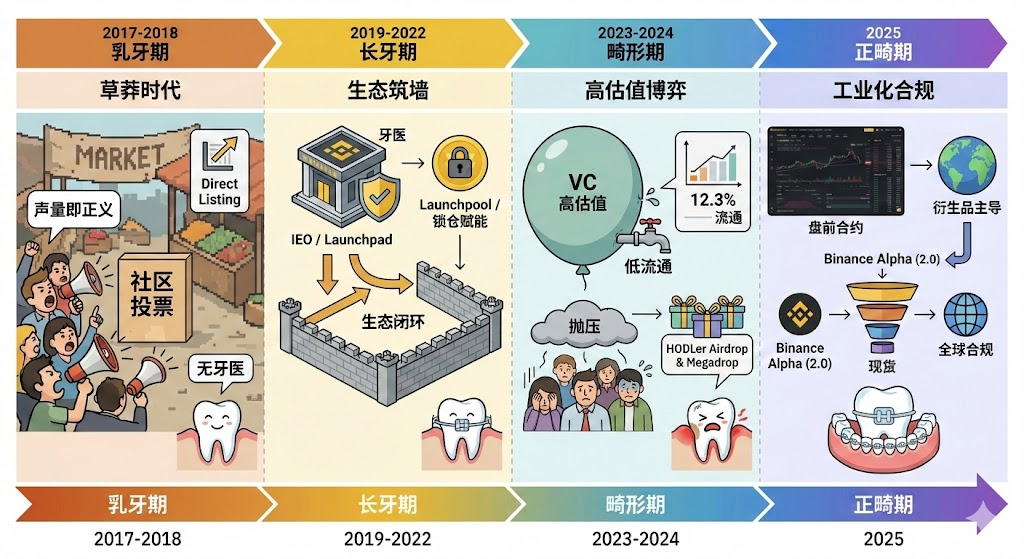
Phase 1 (Community Pricing)
Pricing power rests with those who "pump and dump" and grassroots communities. Traffic is king; whoever has the loudest voice is right. The result is that bad money drives out good, and the market is filled with noise.
Phase Two (Exchange Pricing)
Exchanges regain pricing power through IEOs/Launchpads, acting as "gatekeepers" and "investment banks." The credibility of exchanges has become a core support for asset prices.
Phase Three (The Collapse of VC Pricing)
Venture capitalists (VCs) wielded excessive pricing power in the primary market, rendering the secondary market unprofitable. Exchanges were forced to intervene, attempting to "rob the rich to help the poor" through coercive measures (Airdrop), but this was merely a painkiller, not a fundamental solution.
Phase Four (Market-based/Derivatives Pricing)
Since the funds involved in market speculation are not in the spot market, pricing power is handed over to more mature financial mechanisms. Through "contract trading" and pre-market trading, the market forms a fair price after sufficient competition, no longer relying on a single narrative or VC valuation reports.
Part Two: The Historical Context, Logic, and Evolution of Coin Listing
Phase One: 2017-2018 "Baby Teeth Stage"—A Wild Era Where Voice Determines Justice
Core Paths: Direct Listing, Community Voting
The industry at this time was in a state of "no dentists." The logic behind listing tokens was heavily influenced by founder and community sovereignty; as long as a project could attract fans, it could obtain an entry ticket.
Historical Context
This was the "genesis" of crypto. The industry was still in the era of pure trading platforms, with users primarily focused on the convenience, speed, and low cost of trading. At that time, most mainstream exchanges were slow and unstable, and emerging platforms built their reputation through "extreme simplicity," lacking complex learning systems or social features; their interfaces were designed entirely for experienced professional traders.
reason
Customer acquisition anxiety: Startup platforms need to attract traffic from competitors in a low-cost and efficient manner. "Community voting" is not only about choosing a coin, but also about competing for a sense of community belonging.
Compliance vacuum: Global regulators have not yet intervened, and exchanges have extremely high decision-making freedom. The logic is very simple: whoever has the most followers guarantees liquidity.
How it works: Represented by Binance's "monthly community voting for new listings," users can vote by paying a small amount of tokens (such as 0.1 BNB). Winning projects (such as Zilliqa and Pundi X) gain top-tier traffic almost for free, but due to vote manipulation, the market alignment is severely misaligned, ultimately forcing them to give up.
Phase Two: 2019-2022 "Teething Period"—Building Ecological Walls and Premium Issuance
Core path: IEO (Initial Public Offering), Launchpad, Launchpool, Direct Listing
The industry is beginning to adopt a corrective mechanism called "ecosystem." Exchanges are no longer just intermediaries, but rather "dentists" with in-depth due diligence capabilities.
Historical Context
Following the bursting of the ICO bubble in 2017, fraud and technological vulnerabilities severely damaged the industry's credibility. The market needed a safer and more reputable fundraising method. Meanwhile, the arrival of DeFi Summer (2020) made "liquidity mining" a consensus within the industry.
reason
Credit repair: By introducing "bank-level" due diligence through Launchpad, exchanges act as industry dentists, screening projects with legitimate teams and technologies, and upgrading the ICO model to a more secure IEO (Initial Exchange Offering).
Ecosystem closed loop: In order to strengthen user stickiness, the platform empowers its own ecosystem tokens (such as BNB) through Launchpool, allowing users to obtain new tokens through "holding" rather than "buying", thus reducing the risk of participation.
2019-2020 (IPO frenzy):
Launchpads (such as Bittorrent) have introduced a pricing-based issuance model. Project teams not only have to pass technical reviews, but also accept pricing "suggestions" from exchanges to ensure a certain "wealth effect" after listing.
2021-2022 (Lock-up Empowerment):
Launchpool's rise to mainstream adoption and its empowerment of platform tokens signifies a shift from "buying new tokens" to "mining new tokens." Users lock up platform tokens to receive new token distributions, forcibly binding project interests to the platform ecosystem.
Phase Three: 2023-2024 "Abnormal Period"—The Game of High Valuation and Low Circulation, and Mechanism Upgrades
Core path: HODLer Airdrop, Launchpool
Historical Context
The massive return of venture capital (VC) to the market has spawned a large number of projects valued at hundreds of millions of dollars but with extremely low circulating supply (median only 12.3%). This structure leaves retail investors in the secondary market with virtually no profit potential, only continuous selling pressure from unlocked shares. Meanwhile, CZ (Cai Xing) paid a hefty fine and went to jail, shifting the focus from "unregulated growth" to "global compliance and stability."
reason
Pricing power conflict: VC-driven projects reach their peak upon launch, depriving the market of its price discovery function. To protect the ecosystem, exchanges must use forceful measures to correct this imbalance and "return" profits to the public.
Compliance pressure: Starting in May 2024, the rules explicitly favored small and medium-sized projects with high distribution ratios, requiring project teams to reduce the float portion, in order to combat VC manipulation of pricing.
Corrective measures: Introducing HODLer Airdrop and Megadrop, targeting long-term holders, forcibly distributing the "gift" directly to retail investors.
This is the most painful "periodontalgia" stage in the industry's orthodontic process. VCs have spawned a large number of projects that "peak upon launch," and the median circulating supply of tokens has fallen to 12.3%. Binance's industry report shows that new projects in 2024 alone have a potential selling pressure of approximately $155 billion in the next 12-24 months.
Because venture capital firms manipulated pricing, retail investors bought at high prices, causing the coin to peak immediately upon listing, resulting in a sharp drop in market confidence and severe damage. Poor performance in the secondary market led to a contraction in spot trading volume.
To maintain the platform token's attractiveness, attract users, and drive trading demand, the platform began to implement HODLer Airdrop (airdrops for long-term holders) and Megadrop (distribution combined with Web3 tasks) on a large scale. The listing policy is gradually shifting towards smaller projects with higher distribution ratios.
Starting in the second half of 2024, exchange contract mechanisms underwent a major upgrade, beginning to support a wider range of perpetual contracts for smaller and newer cryptocurrencies. This allowed for risk hedging and early pricing through derivatives before spot liquidity matured. Exchanges also shifted their traffic and revenue sources towards perpetual contract trading.
Phase Four: The "Orthodontic Period" of 2025 – A Multi-Level, Industrialized Compliance Matrix
Core Path: Binance Alpha Airdrop, Pre-Market Trading, Web3 Wallet Integration
Historical Context
2025 is being called the "Year Zero of Cryptocurrency Industrialization." The total market capitalization of digital assets surpassed $4 trillion, with Bitcoin becoming a macro asset. Perpetual contracts have become dominant in the derivatives market, accounting for over 75% of global crypto derivatives trading volume.
reason
Pricing power has shifted: The market is no longer driven by narratives and hype, but by ETF traffic, corporate earnings reports, and agreement revenue.
Efficiency Optimization: Futures First allows pricing of new coins via derivatives before they are listed on the spot market. Data from 2025 shows that this path reduces the conversion cycle to 14 days, making it the fastest way to enter the mainstream market.
Pre-Market: This is the most important mechanism change in 2025. It introduces "Pre-Market" trading, allowing users to trade perpetual contracts with up to 5x leverage based on external price feeds before the token is officially listed on the spot market.
Deep liquidity in altcoins: The massive traffic attracted by contract trading and pre-market trading has drawn numerous small and medium-sized traders, significantly increasing the trading opportunities and liquidity of altcoin contracts. This allows new coins like ESP, AZTEC, and KITE, which haven't yet launched spot trading, to quickly establish derivatives liquidity, becoming the fastest way to enter the mainstream market. The average time from launch to official token issuance is approximately 14 days.
Binance Alpha (2.0): As a "pre-launch token selection pool", projects must first "level up" here to prove their performance in the secondary market (including price trends and trading volume) before they can gradually upgrade from contract to spot.
Part Three: The Power Shift from "Grassroots" to "Industrial Orthodontics"
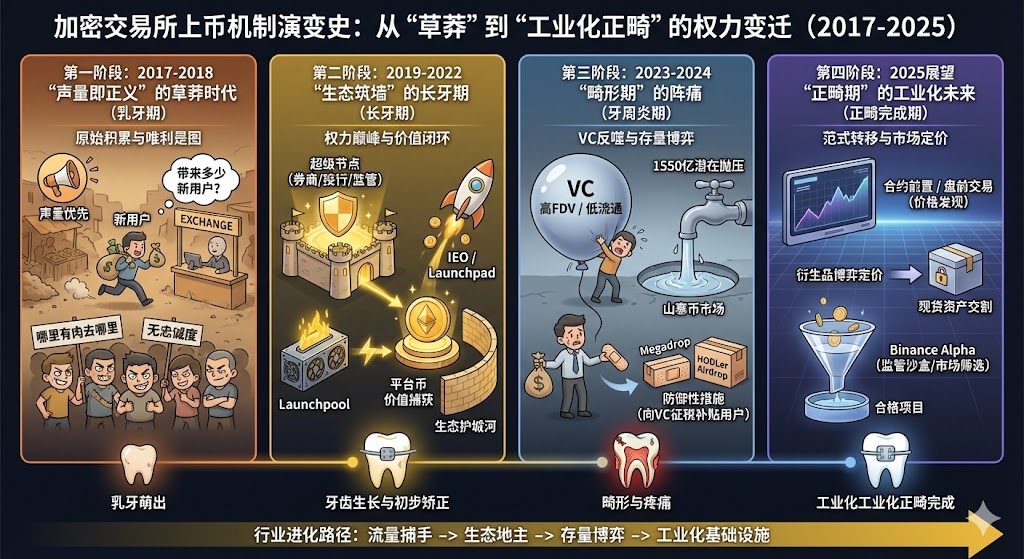
Phase One: The Unofficial Era of "Voice is Justice" (2017-2018)
This was the "primitive accumulation" period for exchanges. They had almost no ability to discern the quality of projects, nor did they need to. They only needed to answer one question: "How many new users will listing this coin bring me?"
This model cultivated the first batch of "profit-driven" crypto users who had no loyalty to the platform or projects, going wherever there was profit to be made, thus foreshadowing the later tragedy of liquidity mining.
Phase Two: The Teething Stage of "Ecological Wall Building" (2019-2022)
Exchanges have reached the pinnacle of power, becoming the top of the food chain. They are not merely trading venues, but super nodes that combine brokerages, investment banks, and regulators. IEOs are the best tool for exchanges to monetize their brand premium.
The shift from "buying new coins" to "mining new coins" (Launchpool) is extremely clever. It successfully forces the benefits of external projects to the platform coin holders, completing a closed loop of value capture for the platform coin. This is the most crucial step in an exchange's construction of its "moat."
Phase Three: The Growing Pains of the "Abnormal Period" (2023-2024)
This is a backlash against the excessive expansion of venture capital (VC) in the previous bull market. Projects with high FDV and low liquidity are essentially a form of institutionalized exploitation of retail investors by VCs, taking advantage of information asymmetry and capital.
The aforementioned "potential selling pressure of $155 billion" is an extremely staggering figure. This explains why the altcoin market remained stagnant while Bitcoin hit new highs. The market not only lacked new funds but was also constantly being drained by the unlocking of older projects.This highlights the predicament of exchanges: knowing full well they're all pitfalls, they still have to keep launching new services to maintain competitiveness. Megadrop and HODLer Airdrop may seem innovative, but they're actually defensive measures by exchanges to maintain ecosystem activity by "taxing" venture capitalists and then subsidizing users. It's a painful "zero-sum game."
Phase Four: The Orthodontic Period of Industrialization's Future (2025 Outlook)
At this stage, the industry finally realized that relying solely on the spot market and simple IEOs, airdrops, and KOL rounds could no longer support the increasingly complex capital needs and community pressures.
During this phase, contracts replace spot trading as the primary means of price discovery and pre-market trading.
First, this represents a massive paradigm shift. Previously, it was "assets first, derivatives second"; in the future, it will be "derivatives will be used for pricing first, followed by physical asset delivery." This significantly accelerates the price discovery process. The true value of a project will no longer be determined by the dramatic price fluctuations at launch, but rather by the pre-market battle between long and short positions in the contracts.
The emergence of Binance Alpha also provided a preliminary window for "industrialized coin listing." Alpha is essentially a "selection sandbox" or a "decentralized curated market." It requires projects to prove their liquidity and resilience in a real, brutal market in order to qualify for "official listing." This replaces the second-stage manual due diligence with a market mechanism.
Part Four: The Evolution of Listing Fees: From Listing Fee – Toll – Membership Fee
This section does not target any particular exchange; it only uses publicly available information as a starting point.
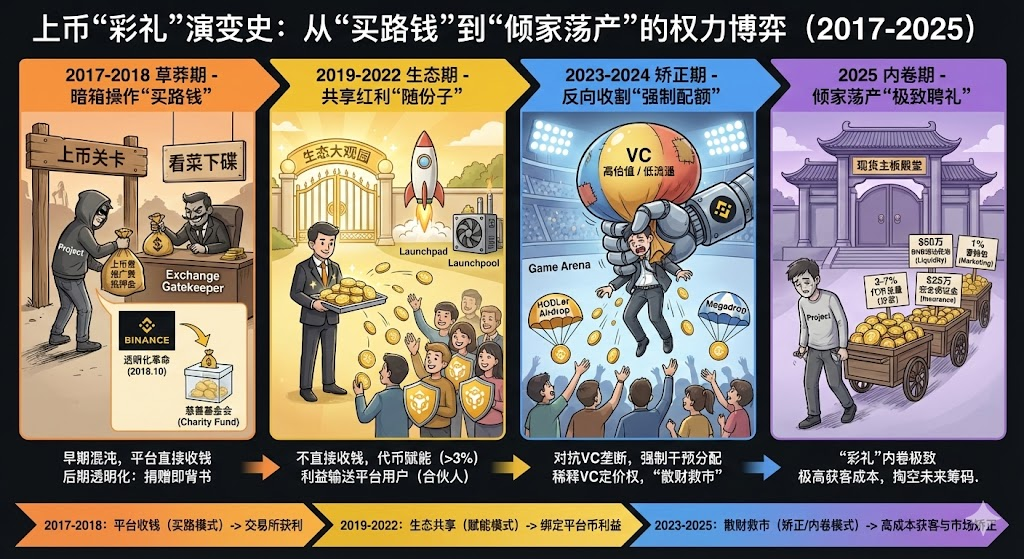
The evolution of "listing fees" in these four stages is essentially a process of power shift within the industry: from initially "paying the platform a toll" to now "spending all your wealth to acquire traffic." We can see how the industry has evolved step by step through this evolution of "dowry" perspective.
The following is a discussion of four stages of listing fee models:
Phase 1 (2017-2018): From "Toll Money" to "Gifts at Weddings"
In the early, chaotic period, rumors about exorbitant listing fees were rampant, and each exchange was in a state of adjusting its fees according to the situation, with countless charges: listing fees, event fees, promotion fees, collateral deposits, and so on.
In October 2018, Binance underwent a transparency revolution, announcing that 100% of all listing fees would be donated to a charitable foundation. Listing fees shifted from being "direct revenue for the platform" to "endorsement of brand reputation."
Phase Two (2019-2022): The Exchange of "Ecological Dividends"
During this period, the direct payment model was abandoned. It was replaced by "ecosystem empowerment," where project teams were required to distribute tokens to platform users (mainly platform token holders).
Taking Binance as an example, pricing and issuance are done through Launchpad, or liquidity mining is done through Launchpool.
Although there is no "listing fee" in name, project teams must set aside a certain percentage of tokens (usually 2-3% or more of the total supply) as distribution tokens. This money no longer goes to the exchange, but to the "partners" who can support the platform's ecosystem.
Phase Three (2023-2024): Countering VC Monopoly with "Mandatory Quotas"
With the proliferation of "overvalued, low-circulation" tokens, exchanges began to forcibly intervene in profit distribution. At this time, Binance was embroiled in the infamous "x% token listing fee" rumor, sparking a major debate within the industry. Subsequently, the official response stated that the so-called project tokens were not given to the exchange, but rather were required by the project team to be used for user airdrops and community rewards.
By implementing methods such as HODLer airdrops, Launchpool, and Megadrop, projects are forced to "dilute" VCs' pricing power by distributing tokens on a large scale in the early stages of their listing.
Phase Four (2025 onwards): "Bankruptcy-level" dowries with inverted value
By 2025, the "dowry" (competition fee) for entering the spot motherboard market had reached its peak of intense competition. The following phenomena emerged:
Distribution ratio increased: The average distribution ratio stabilized at 3% to 7% of the total token supply (from alpha to spot).
Margin Mechanism: In addition to tokens, project teams typically need to deposit at least $250,000 in security deposit (refundable after 1-2 years) and prepare a liquidity pool of at least $500,000 in BNB.
Marketing Package: Approximately 1% of the supply is allocated to platform marketing.
From 2017 to 2025, the logic behind listing fees has undergone three major leaps:
2017-2018: The platform collected money (for tolls).
2019-2022: Ecosystem Sharing (Empowerment).
2023-2025: Spending money to save the market (correction).
The "listing fee" has now completely evolved into a customer acquisition cost. In order to obtain liquidity from top platforms, project teams often pay a token value exceeding their total fundraising amount. While this "bride price" model guarantees users' initial returns, it also causes many projects to almost deplete their future growth potential on their "wedding day."
Part 5: What should we say as industry participants?
This text is not only a review of history, but also an evolutionary report on the survival philosophy of exchanges and project teams.
It demonstrates how exchange players, represented by Binance, have adjusted their positioning in different cycles: from the initial "traffic hunter" to the "ecosystem landlord", and after encountering the crisis of "VC harvesting", they finally chose to evolve into "industrialized financial infrastructure".
In the future, listing a new coin will no longer be a simple "bell-ringing ceremony," but a complex, multi-layered financial engineering project. For project teams, the era of simply writing white papers and raising VC funding is over; for retail investors, the window of getting rich quick by blindly participating in new coin offerings has also closed. What will be needed in the future is more professional trading skills and an understanding of derivatives instruments.