




Author:Wall Street observations
Just as OpenAI was close to finalizing a new round of financing of approximately $100 billion, Anthropic had just completed a large financing round of approximately $30 billion. What has attracted even more market attention is that at least 12 of OpenAI's direct institutional investors also appeared on the list of backers behind Anthropic's latest round of financing.
This list of institutions engaging in "dual betting" not only includes hedge funds or asset management companies accustomed to hedging bets such as D1, Fidelity, and TPG, but more shockingly,Top venture capital firms that traditionally value "choosing sides," such as Founders Fund, Iconiq, Insight Partners, and Sequoia Capital, also participated.
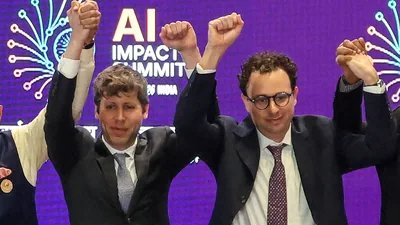
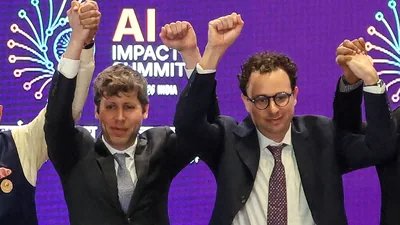
Photo: During a group photo at the recent AI Summit in India, OpenAI CEO Sam Altman and Anthropic CEO Dario Amodei stood side by side but refused to hold hands.
BlackRock's "Dual Identity"
The most notable conflict of interest comes from global asset management giant BlackRock. Although Adebayo Ogunlesi, a senior managing director and board member of BlackRock, currently serves on the board of OpenAI, BlackRock's affiliated funds still participated in Anthropic's $30 billion funding round.
In the public market, it's commonplace for asset management firms to hold shares in their competitors, and Microsoft and Nvidia's extensive hedging portfolios across various AI companies are well-known. But for venture capital (VC), this represents a disruption of traditional practices.
VCs have long touted themselves as "founder-friendly" and "helpful." Their core logic is that when a VC holds a significant stake in a startup, they will fully support it in combating major competitors. Furthermore, as private companies, startups typically disclose confidential business data to direct investors that publicly traded companies would not.
Today, that line has become blurred. "If you own both OpenAI and Anthropic, to whom else can you remain loyal besides your own LPs (limited partners)?"
One investor interviewed bluntly stated, "As long as the company doesn't occupy a seat on the board of directors, no one thinks it's harmful anymore."
OpenAI's "blacklist"
OpenAI CEO Sam Altman is a seasoned venture capitalist. As the former president of Y Combinator, he had long been aware of this trend.
According to TechCrunch, Altman provided investors with a list of OpenAI competitors he did not want them to support in 2024, including companies founded by former OpenAI employees such as Anthropic, xAI, and Safe Superintelligence.
While Altman later denied excluding a competitor from future funding rounds due to investor support, he drew a clear line regarding disclosures concerning core interests. According to documents disclosed in the Elon Musk v. OpenAI lawsuit, Altman admitted he had explicitly informed investors:
“If they make non-passive investments, they will no longer receive confidential business information from OpenAI.”
Capital finds it hard to say "no".
The unique nature of the AI industry is breaking all established patterns. Large AI labs are experiencing unprecedented growth, while simultaneously facing a record funding gap for building data centers.
The article argues that when the demand for financing is so huge and the potential returns are astronomical, it is difficult to expect investors to say "no".
Nevertheless, not all venture capitalists have slid down the slope of "double betting".
Andreessen Horowitz (a16z)Currently, it supports OpenAI but has not yet invested in Anthropic.
Menlo VenturesSupports Anthropic, but has not yet invested in OpenAI.
Bessemer, General Catalyst and GreenoaksThese institutions appear to have only directly invested in one of them so far.
However, it is undeniable that the breaking of this long-standing rule by respected Silicon Valley institutions like Sequoia Capital marks a fundamental shift in the market environment. For founders, regardless of who submits the letter of intent, conflict of interest policies must now be a key clause to be questioned before signing any investment agreement.