




Author:Currency Explorer
Trump's new 10% global tariffs took effect on Tuesday, kicking off the White House's efforts to maintain the president's trade agenda after the Supreme Court rejected his original comprehensive tariffs.
Just hours after the Supreme Court ruling last Friday, Trump signed an executive order authorizing a 10% tariff on imports. He subsequently threatened to raise that figure to 15%, but as of 12:01 a.m. Washington time on Tuesday when the 10% tariff took effect, Trump had not formally issued a directive to raise the rate.
According to an administration officialThe White House is drafting a formal order to raise global tariffs to 15%.The official, who requested anonymity to discuss internal affairs, said the timeline for implementing the higher tariffs has not yet been finalized.
Washington's lack of transparency has sparked confusion globally regarding Trump's tariff agenda. Countries and companies are scrutinizing existing trade agreements to determine their position in the face of Trump's latest threats.Major trading partners, including the EU and India, abruptly suspended ongoing trade negotiations amid this uncertainty.
Trump imposed the 10% base tariff under Section 122 of the Trade Act of 1974, a provision that allows the president to impose the tariff for 150 days without congressional approval. He switched to this approach after a court ruled that he violated the Emergency Powers Act by imposing so-called “reciprocal” tariffs on goods from around the world.
The order retains several exemptions, including exemptions for goods that comply with the North American Trade Agreement between the United States, Canada, and Mexico, as well as exceptions for some agricultural products that existed under the tariffs that Trump vetoed.
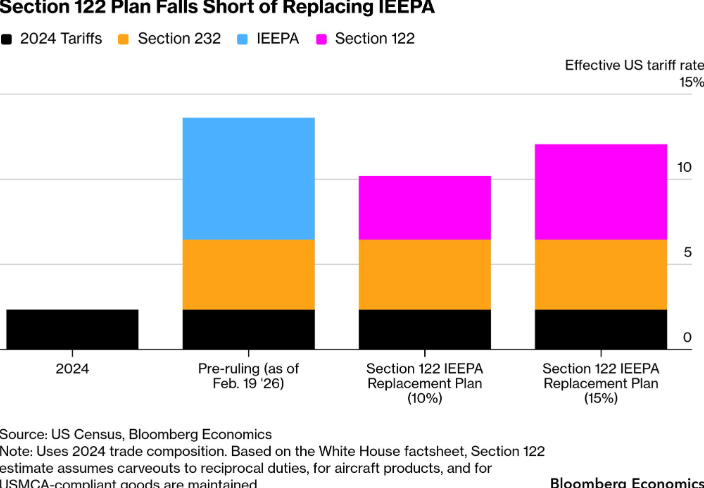
According to an analysis by Bloomberg Economics, including these exemptions, the average effective tariff rate in the United States will stabilize at around 10.2%, down from 13.6% before the court ruling. The study estimates that this effective rate would be around 12% under a 15% global tariff.
Trump's team stated thatTariffs will remain central to his trade policy, and he reiterated his plan to expedite a series of investigations to enable him to unilaterally impose tariffs—all in an effort to rebuild the tariff system that court rulings have effectively destroyed.
The authorizations already granted by the White House—such as Sections 301 and 232—are not as flexible as the emergency powers Trump previously used to influence trading partners. The administration has not yet announced new trade investigations, which could take months to complete.
In response to the Supreme Court's ruling, government officials urged trading partners to abide by agreements negotiated with the United States over the past year. U.S. Trade Representative Greer stated on CBS's "Face the Nation" program last Sunday, "We want them to understand that these are good agreements. We will abide by these agreements. We expect our partners to abide by these agreements as well."
This argument is less reassuring for some major economies. The EU froze approvals of its trade agreement with the US on Monday, awaiting Trump's finalization of his latest tariff plans. In New Delhi, officials postponed talks this week with India to finalize a temporary trade agreement in the US, citing similar reasons.
On Monday, Trump threatened to impose higher tariffs on partners who "play tricks" on existing agreements. European Central Bank President Christine Lagarde stated on "Face the Nation" that it is "crucial" for global trade to "get a clear message from the U.S. government."
Trump's threat to raise global benchmark tariffs to 15% has also shaken some traditional allies who had agreements with him. The UK, which negotiated a 10% tariff last year, could face a more difficult situation for its exporters if the rate were higher.
At the same time, with Trump's emergency powers being limited, other more confrontational countries may be in a better position in negotiations with him.
Hours after these tariffs take effect, Trump is expected to deliver his State of the Union address to Congress.Democrats and some Republicans who oppose parts of his trade policy will be in attendance. The prime-time speech is expected to focus on his economic agenda, as Republicans attempt to tailor a midterm election message to voters frustrated by the cost of living.
Polls show growing public dissatisfaction with Trump's trade policies and a growing belief that these policies have driven up prices. A Washington Post/ABC News/Ipsos poll found that...64% of Americans disapprove of Trump's handling of tariffs.34% of people agree with this.