




Author:Wall Street CN
While the US market was gripped by an "AI panic sell-off," with investors dumping software companies and wealth management firms, Chinese investors were buoying up AI-related stocks. This starkly contrasting market sentiment reflects a fundamental divergence in how investors in the two countries view AI technology: the US is concerned about the disruption of existing business models, while China is focused on growth opportunities and cost reduction potential.
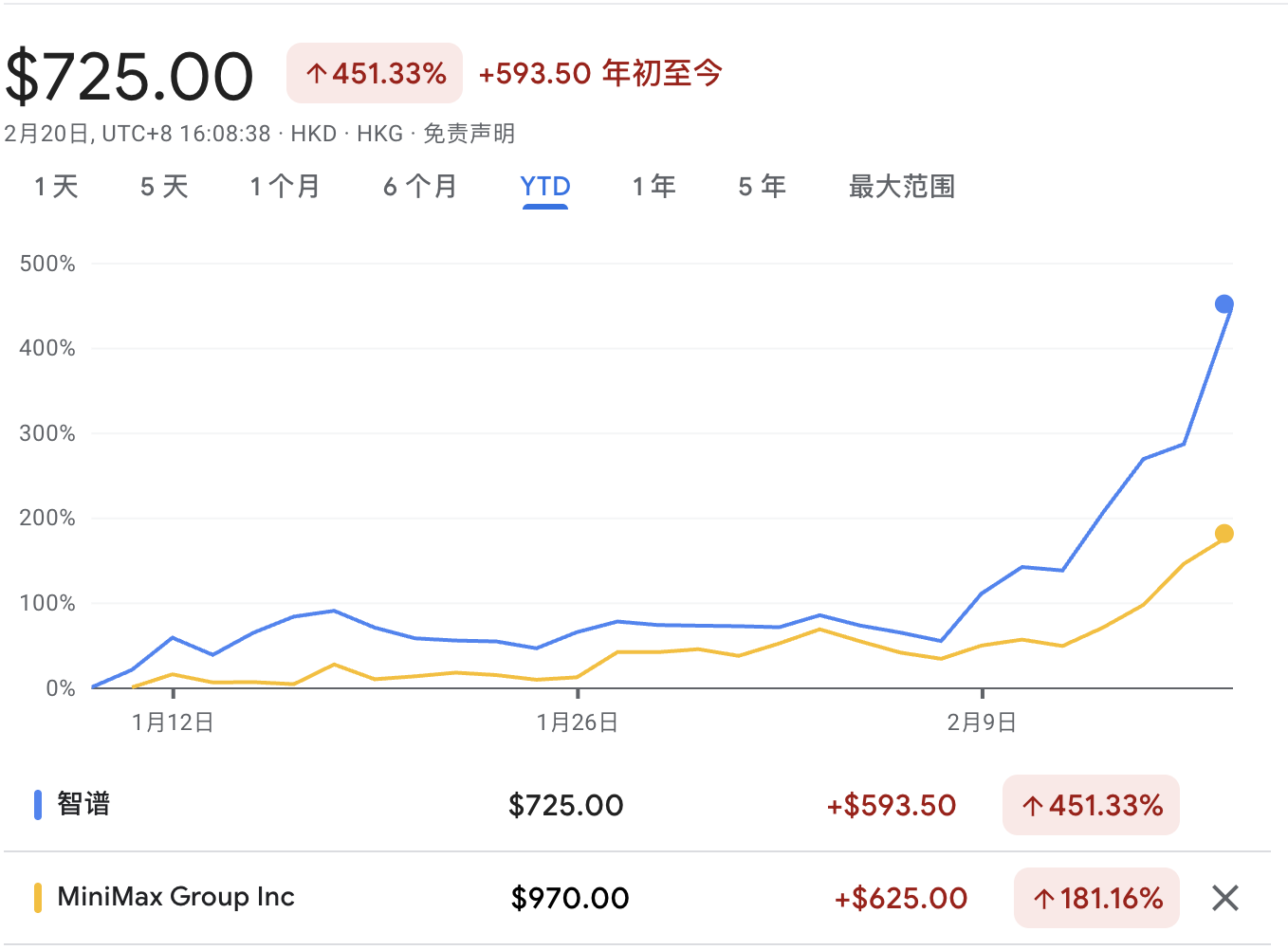
Domestic companies that released new models or upgraded existing products this month have become investor favorites. MiniMax and Zhipu AI are the most typical examples, with both companies' stock prices doubling in February. Bullish ratings from Wall Street investment banks such as Morgan Stanley have further fueled market enthusiasm, and pure AI concept stocks are snatching funds from traditional internet giants.
This market divergence stems from differences in investment logic. Charu Chanana, Chief Investment Strategist at Saxo Bank, stated...The Chinese market remains focused on what AI can help with, rather than what it will take away from existing companies. While US investors are anxious about the competitive threat to lucrative profit pools, China's focus remains on market penetration.
Newly listed AI stocks led the gains.
MiniMax and AI Spectrum have attracted investors, partly due to the scarcity of publicly traded companies globally that build large-scale models. Both companies listed in Hong Kong in January, with AI Spectrum's share price subsequently surging by as much as 524% and MiniMax by 488%. In contrast, OpenAI and Anthropic, considered industry pioneers, remain unlisted.
Other recently listed Chinese AI-related stocks have also performed strongly. Chip designer Biren Technology has risen more than 80% since its listing on January 2, and Montage Technology has surged more than 98% since its listing on February 9.
Domestic companies also benefited from the halo effect, with the private equity funding rounds of two US companies showing a continuous rise in valuation. OpenAI raised more than $100 billion at a valuation of over $850 billion, while Anthropic raised $30 billion in early February at a valuation of $380 billion.
Technological breakthroughs boost valuations
The release of new models and funding data have driven a revaluation.Jefferies analysts Edison Lee et al. wrote in a research report on February 13: "There is upside potential for Chinese AI valuations."
GLM-5, the latest large language model recently released by Zhipu AI, has surpassed its competitor, launched by Moonshot AI a few weeks earlier, on the benchmark website Artificial Analysis, becoming the world's top open-source model. According to a Jefferies report, this is the highest ranking ever achieved by a Chinese AI lab.
Some market enthusiasm is related to DeepSeek, with the market anticipating its upcoming release of its next-generation model, which could boost the entire sector. The market also expects that the cost competitiveness of Chinese AI models like DeepSeek may accelerate user adoption.
Currently, domestic investors view every new development in AI as a catalyst, benefiting not only developers but also users of new tools. ByteDance's recent launch of a video production app triggered a collective rise in film and media stocks.
"The divergence between Chinese market participants and global investors reflects the structural uniqueness of China's AI landscape," said Gary Tan, portfolio manager at Allspring Global Investments. However, some market observers warn that if earnings growth fails to keep pace with investor optimism, valuation rebalancing may be unsustainable.